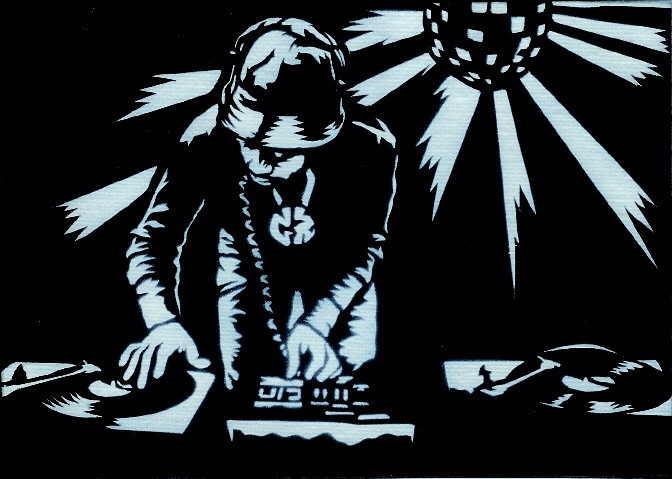
Deejaying:
Any individual who plays a record on a turntable can call herself a Deejay. However hip jump deejaying, or turntablism, is a mind boggling workmanship. At its most straightforward it comprises of a couple of turntables, a sound blender, and unique recordings. Upon these the disk jockey performs strategies, for example blending, scratching, cutting, and testing, to make a totally new bit of music from the first ever track.
The bases of hip jump deejaying lie in the Jamaica of the 1950s and '60s, where the sound framework was a proficient approach to transport music around the nation, and the Djs were well known and frequently showy performers.
Musically it was a creative period, with the attention on cadenced experimentation. The afterbeat, the rock relentless beat, ska, name and reggae all advanced throughout this period.
Also emcees were testing with music, as well as with engineering. In 1968 King Tubby made the name style of music by forgetting partitions of the vocal tracks on a name plate (the nearby term for the acetic acid derivation disc), and adequately making another form of a melody - what might today be known as a 'remix'.
In the 1960s numerous Jamaicans emigrated to the Usa, winding up in the inward city ghettos of New York. One of these settlers was Dj Kool Herc. In the late 1960s he used to disk jockey at gatherings, where he might serenade ad libbed rhymes over the instrumentals and breaks of ubiquitous melodies. Since these interims weren't generally long enough to get an exceptional rhyme going, he might put two duplicates of the same record on the turntables and utilize a sound blender to switch between them, permitting him to circle the breaks for inasmuch as he required - hip-bouncing on the turntable. These came to be reputed to be "breakbeats" - and hip bounce deejaying was conceived.
All around the 1970s and '80s deejaying systems got regularly complex as the music and the engineering improved side by side. Hip bounce and electro musical performers will think over with affection on such excellent instruments as the Moog Synthesizer, the Tr-808 drum machine, and the Technics 1200 turntable - the disk jockey's Stradivarius!
The point when scratch emcee Mix Master Mike joined the Beastie Boys in 1998, scratching truly made it to the standard, and shaped an unique association with Nu-Metal. Groups, for example Limp Bizkit, Linkin Park and Incubus added an emcee to the conventional guitar-bass-drums line-up.
Hip bounce cognoscenti will hotly banter about precisely when, where and who concocted such strategies as cutting, scratching, beat juggling, and breakdown. However it was Grandmaster Flash and Grand Wizard Theodore, the New York disk jockeys, who presented to all these styles and traps to a more extensive crowd. The 1981 collection The Adventures of Grandmaster Flash on the Wheels of Steel is a prime sample of unanticipated turntablism, and was a milestone hip bounce discharge.
In spite of the abundance of innovations now accessible to contemporary craftsmen, these strategies remain the crucial stockpile of any turntablist.

No comments:
Post a Comment